

















Web3 Foundation: Introduction to Polkadot

Understanding Polkadot’s Role in the Next Generation of Blockchain About this course Developed by the Technical Education team at the Web3 Foundation, this course provides a comprehensive overview of Polkadot Network, its technology and ecosystem. This course features the founders of Polkadot who introduce its vision, features and architecture. First, the learners are introduced to…
Understanding Polkadot’s Role in the Next Generation of Blockchain
About this course
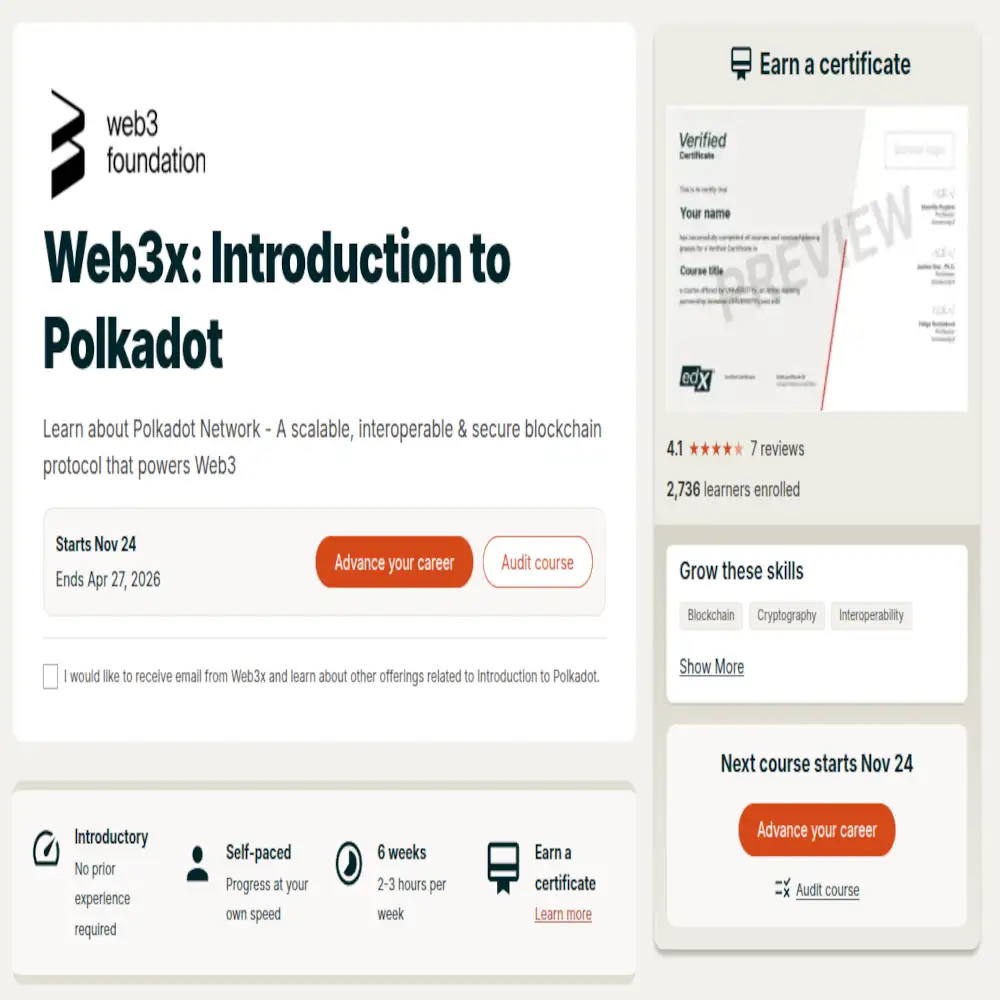
Developed by the Technical Education team at the Web3 Foundation, this course provides a comprehensive overview of Polkadot Network, its technology and ecosystem.
This course features the founders of Polkadot who introduce its vision, features and architecture. First, the learners are introduced to the key terminology and are shown how to interact with the Polkadot network with numerous hands-on activities. Later, we dive deeper into the concepts of the shared security, interoperability, cryptography and networking aspects of Polkadot. We wrap up the course by taking a look at the development happening on the Polkadot ecosystem and how to get involved.
The course is open to learners with foundational knowledge on Blockchain.
source: https://www.edx.org/learn/computer-programming/web3-foundation-introduction-to-polkadot
The blockchain landscape is evolving beyond single-chain ecosystems, and at the forefront of this interoperability revolution is Polkadot. Created by Dr. Gavin Wood, a co-founder of Ethereum, this ambitious project aims to solve some of the most pressing challenges in Web3. For anyone seeking to understand the future of decentralized networks, an introduction to Polkadot from the official Web3 Foundation is not just beneficial—it’s essential. It provides the conceptual framework for a truly multi-chain internet, a vision central to the next era of Blockchain technology.
While early Blockchain networks like Bitcoin and Ethereum pioneered decentralization, they often operate as isolated islands. This fragmentation limits their potential and scalability. The Web3 Foundation envisions a different future, one where diverse blockchains can communicate and share security seamlessly. This is the core problem that Polkadot is designed to solve, acting as a foundational layer for a connected and scalable web of specialized chains.
Donation
Coffee to stay awake, thank you very much for your contribution to keeping our website online.
Image Credit: Web3 Foundation
The Architectural Vision of the Web3 Foundation
The Web3 Foundation doesn’t just promote a single cryptocurrency; it champions a new architectural paradigm for the internet. Their work on Polkadot is a direct manifestation of this philosophy. The foundation’s goal is to nurture cutting-edge technologies and applications in decentralized web software, and Polkadot serves as the backbone for this ecosystem. By providing grants and educational resources, the Web3 Foundation ensures that the vision of a user-centric internet, built on robust Blockchain technology, continues to grow and attract top-tier developers.
Deconstructing the Polkadot Protocol: Relay Chain and Parachains
To grasp the innovation of Polkadot, you must understand its multi-component architecture. At its heart is the Relay Chain, the network’s “main chain” responsible for consensus and shared security. Attached to it are parachains—independent, customizable blockchains that leverage the Relay Chain’s security. This design is revolutionary because it allows projects to build their own specialized Blockchain without the immense burden of bootstrapping their own validator set. The Web3 Foundation emphasizes how this shared security model is a game-changer for scalability and interoperability.
The Power of Interoperability and Cross-Chain Communication
What truly sets Polkadot apart is its native ability for parachains to interoperate. Through the Cross-Consensus Message Format (XCM), these independent chains can exchange any type of data or asset. This means a decentralized exchange on one parachain can seamlessly interact with a gaming application on another. This level of interoperability, a key focus of the Web3 Foundation, unlocks possibilities that are simply not feasible on isolated Blockchain networks. It paves the way for complex, multi-chain applications that define the future of Web3.
Governance and Upgradability in the Polkadot Ecosystem
Another cornerstone of the Polkadot network is its sophisticated on-chain governance system. Unlike many legacy Blockchain projects that require contentious hard forks to upgrade, Polkadot enables seamless, forkless upgrades. DOT token holders can propose and vote on referenda to evolve the network protocol. The Web3 Foundation designed this system to ensure that Polkadot remains adaptable and community-led, preventing stagnation and aligning the network’s development with the long-term interests of its stakeholders.
Donation
Coffee to stay awake, thank you very much for your contribution to keeping our website online.
Image Credit: Web3 Foundation – Polkadot JS
Polkadot and Parachains
Introduction to Polkadot from the founders, vision of Polkadot and an overview of Polkadot network architecture – relay chain, parachains and network protocol. Introduction to the concepts of scalability, interoperability and security. Introduction to Kusama – testnets and canary networks. Becoming a Parachain on Polkadot.
Interacting with Polkadot Network
DOT as a network utility token. Creating and restoring accounts, existential deposit, balance transfers, wallets, staking and validating, participating in governance, setting on-chain identity. Block explorers. On-chain Governance and treasury.
Polkadot Security and Consensus
Nominated Proof of Staking. BABE. GRANDPA Finality gadget. Role of Nominators and Validators. Availability and Validity. Erasure coding. Shared Security – Ethereum vs Polkadot vs Cosmos. Security and Consensus improvements.
Polkadot Cryptography and Networking
Account keys and session keys. Overview of networking – gossiping, distributed service, storage and availability, authentication, transport and discovery. Polkadot telemetry. Full nodes and Light clients. Path of a Parachain block. Challenges and scope for improvements.
Interoperability and Scalability
Polkadot interoperability protocol in depth. Relay chain vs parachain. Validity and availability. Cross chain messaging (XCM). Introduction to parathreads and common good parachains. Statemint. Teleporting assets.
Polkadot for Developers
Introduction to Rust. Introduction to Substrate . Polkadot-JS and APIs. Wasm and Polkadot as a Wasm meta-protocol. Polkadot ecosystem and developers social channels. Substrate recipes and Playground. Westend and Rococo. Ink! smart contracts. Polkadot ecosystem.
source: https://www.edx.org/learn/computer-programming/web3-foundation-introduction-to-polkadot
Frequently Asked Questions About Polkadot
- How is Polkadot different from Ethereum? While both are platforms for decentralized applications, Polkadot focuses on interoperability and allowing multiple specialized chains (parachains) to run in parallel, whereas Ethereum primarily operates as a single, general-purpose Blockchain.
- What is the role of the DOT token? DOT serves three key functions: governance (voting on network upgrades), staking (securing the network), and bonding (connecting a parachain to the Relay Chain).
- Do I need to be a developer to get involved with Polkadot? Not at all. While developers can build parachains, anyone can participate by becoming a nominator to help secure the network, or by engaging in the governance process as a DOT holder.
- What is a parachain slot and how do you get one? A parachain slot is a lease to connect a chain to the Relay Chain. Projects typically acquire them by winning a parachain auction, where they crowdloan DOT tokens from the community to bid.
Conclusion
The Final Verdict on Polkadot’s Multi-Chain Future, the vision put forth by the Web3 Foundation through Polkadot represents a fundamental shift in how we conceptualize blockchain architecture. It moves beyond the one-chain-fits-all model to a heterogeneous, interconnected ecosystem. By solving critical issues of scalability, interoperability, and governance, Polkadot positions itself as a critical piece of infrastructure for the next decade of Blockchain innovation. The educational resources provided by the Web3 Foundation offer the clearest path to understanding this complex but transformative technology, making its “Introduction to Polkadot” an invaluable resource for any serious Web3 enthusiast.
What potential application of interconnected blockchains excites you the most? Do you see a future where specific industries are powered by their own specialized parachains? Share your thoughts and questions about the Polkadot ecosystem in the comments below.
Source
- https://www.edx.org/learn/computer-programming/web3-foundation-introduction-to-polkadot