












Web3 Foundation: Introduction to Blockchain and Web3

Why Understanding Web3 is Essential for the Digital Future About this course Developed by the Technical Education team at the Web3 Foundation, this course introduces the fundamental concepts of Blockchain technology and Web3. First, we go over the history and the key terminology of blockchains, Bitcoin, Ethereum and Web3 and then take a deep dive…
Why Understanding Web3 is Essential for the Digital Future
About this course
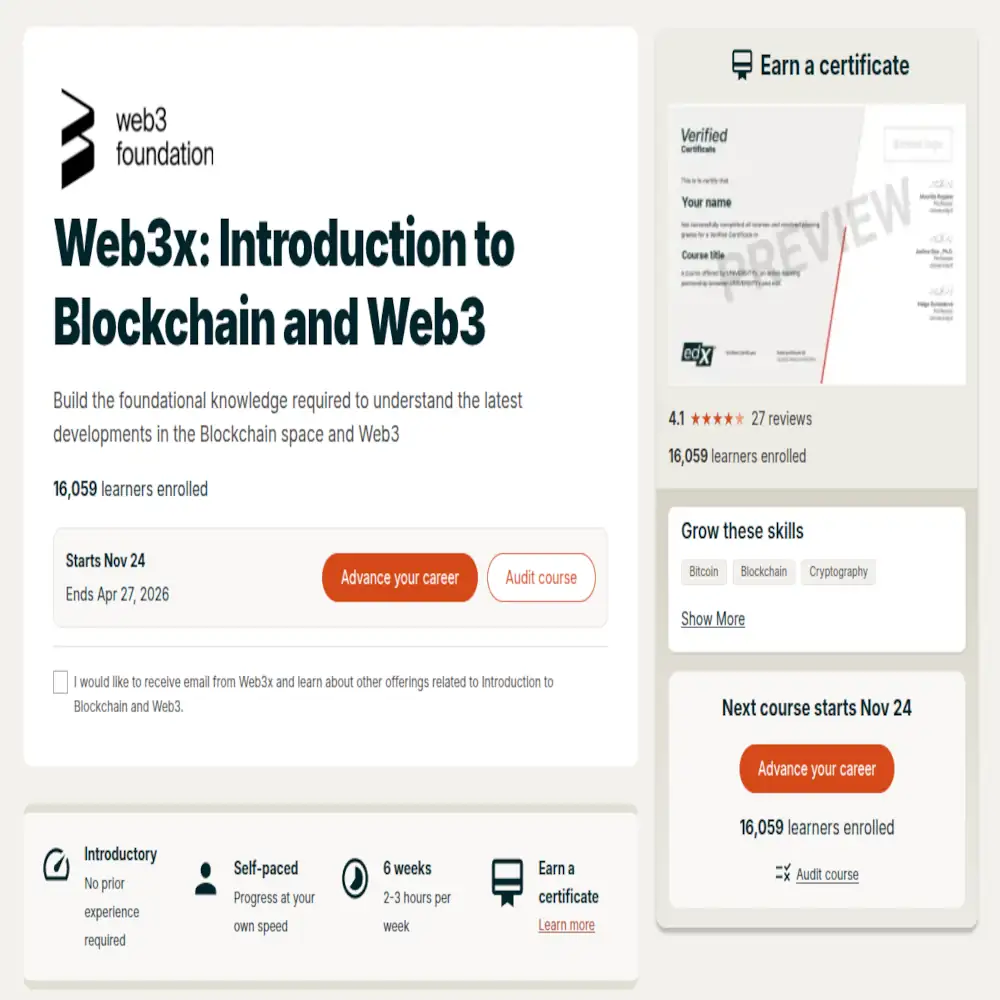
Developed by the Technical Education team at the Web3 Foundation, this course introduces the fundamental concepts of Blockchain technology and Web3.
First, we go over the history and the key terminology of blockchains, Bitcoin, Ethereum and Web3 and then take a deep dive into the technology that powers blockchains. The concepts of cryptography and hashing in the context of blockchains are explored along with hands-on activities that familiarize the learners with digital wallets and blockchain explorers. Next, we explore the concepts of block production and finality, consensus, nodes and networking in blockchain networks. Towards the end of the course, we will explore the blockchain layers and applications centered around networks like Bitcoin, Ethereum and Polkadot. We wrap up the course by exploring the current landscape of Web3 and the future of blockchain technology.
The course is open to learners from all backgrounds. The key objective of this course is to provide a strong foundational knowledge pertaining to Blockchain and Web3.
source:
- https://www.edx.org/learn/blockchain/web3-foundation-introduction-to-blockchain-and-web3
We are standing at the precipice of a new digital era, one that promises to reshape our online interactions, economies, and very concept of ownership. This paradigm shift is powered by a technology known as Blockchain, and its most profound application is the evolution into Web3. For anyone looking to not just witness but actively participate in this change, the foundational knowledge offered by the Web3 Foundation course, “Introduction to Blockchain and Web3,” is an indispensable starting point. It demystifies the core principles that are building a more decentralized and user-centric internet.
The journey from the static pages of Web1 to the interactive, platform-dominated Web2 has been dramatic. Now, Web3 emerges as the answer to the centralization and data privacy concerns of our current online experience. It’s a vision of an internet where users own their data, digital assets, and identity. The Web3 Foundation provides a structured lens through which to view this complex transition, breaking down the technological bedrock that makes it all possible.
Donation
Coffee to stay awake, thank you very much for your contribution to keeping our website online.
Image Credit: Web3 Foundation
The Architectural Shift from Centralized Servers to Distributed Ledgers
At its heart, the move to Web3 is an architectural revolution. Instead of relying on centralized servers owned by corporations, Web3 is built on a Blockchain, a distributed and immutable ledger. This means data is not stored in a single location but is copied and spread across a network of computers. This foundational concept, which the Web3 Foundation course explores in depth, introduces a new level of transparency and security. It’s the difference between entrusting a single entity with your information and having a communal, unchangeable record that no single party controls.
Decoding the Core Pillars of the Web3 Vision
The vision promoted by the Web3 Foundation rests on several interdependent pillars. Understanding these is key to grasping the full scope of Web3. First is Blockchain technology itself, the trustless and transparent foundation. Second are smart contracts, self-executing contracts with the terms directly written into code, which automate agreements without intermediaries. Third is decentralization, the principle of distributing power and control away from central authorities. Finally, user sovereignty ensures that individuals have true ownership over their digital assets and data.
Practical Applications Beyond Cryptocurrency
While Bitcoin introduced the world to the potential of Blockchain, the Web3 Foundation curriculum illuminates the vast landscape of applications that extend far beyond digital money. This new paradigm is enabling:
- Decentralized Finance (DeFi): An open, global financial system built on Blockchain that is accessible to anyone with an internet connection.
- Digital Ownership and NFTs: Non-fungible tokens (NFTs) provide verifiable proof of ownership for digital art, collectibles, and even real-world assets.
- Decentralized Autonomous Organizations (DAOs): Community-led entities with no central authority, governed by smart contracts and member votes.
- The Creator Economy 2.0: Empowering artists and creators with new ways to monetize their work and connect directly with their audience.
These are not distant futures; they are live technologies being built today.
The Role of the Web3 Foundation in Ecosystem Education
Navigating this nascent field can be overwhelming. The role of an organization like the Web3 Foundation is crucial. They act as a curator and educator, providing a clear, unbiased entry point for learners. Their “Introduction to Blockchain and Web3” course is more than just a list of definitions; it’s a framework for understanding how these technologies interconnect to form a coherent new internet stack. By focusing on first principles, the Web3 Foundation equips students with the mental models needed to critically evaluate new projects and trends.
Donation
Coffee to stay awake, thank you very much for your contribution to keeping our website online.
Image Credit: edX Platform
Frequently Asked Questions for Web3 Curious Minds
- Is Web3 just another name for cryptocurrency? No, cryptocurrency is just one application built on Blockchain technology. Web3 is a much broader vision for a decentralized internet that includes social media, finance, and identity.
- Do I need to be a programmer to understand this? Absolutely not. While developers are crucial builders, the philosophical and economic implications of Web3 are relevant to everyone. The Web3 Foundation course is designed for a broad audience.
- What is the biggest challenge facing Web3 adoption? Current challenges include improving user experience (UX), scaling transactions to be faster and cheaper, and navigating an evolving regulatory landscape that the Web3 Foundation often discusses.
- How do I start using Web3 applications? The first step is usually setting up a self-custody crypto wallet, like MetaMask. This wallet becomes your passport to interacting with dApps (decentralized applications).
The Final Verdict on Embracing the Decentralized Web
In conclusion, the transition to Web3 represents one of the most significant technological shifts of our generation. Ignoring it means risking obsolescence in the next iteration of the internet. The foundational knowledge provided by the Web3 Foundation is not just for technologists; it’s for entrepreneurs, artists, investors, and any curious mind who wants to understand the forces shaping our digital future. The course offers the vocabulary and conceptual understanding necessary to navigate this new frontier with confidence. The internet is being rewired, and through the educational efforts of the Web3 Foundation, we all have a chance to be a part of its construction.
Source
- https://www.edx.org/
- https://www.edx.org/learn/blockchain/web3-foundation-introduction-to-blockchain-and-web3
What aspect of the Web3 vision are you most excited about or skeptical of? Is it the potential for DeFi, the new models for digital creativity, or the concept of DAOs? Share your perspective and questions in the comments below, let’s build this understanding together.

HJunior
I am HJunior, SEO Writer, Copywriter, and enthusiastic and passionate about technology, future blockchain programmer.
Facebook
Twitter
LinkedIn
Instagram
Youtube
Edit Template